Embodied Internal Family Systems
Heal through the wisdom of your body
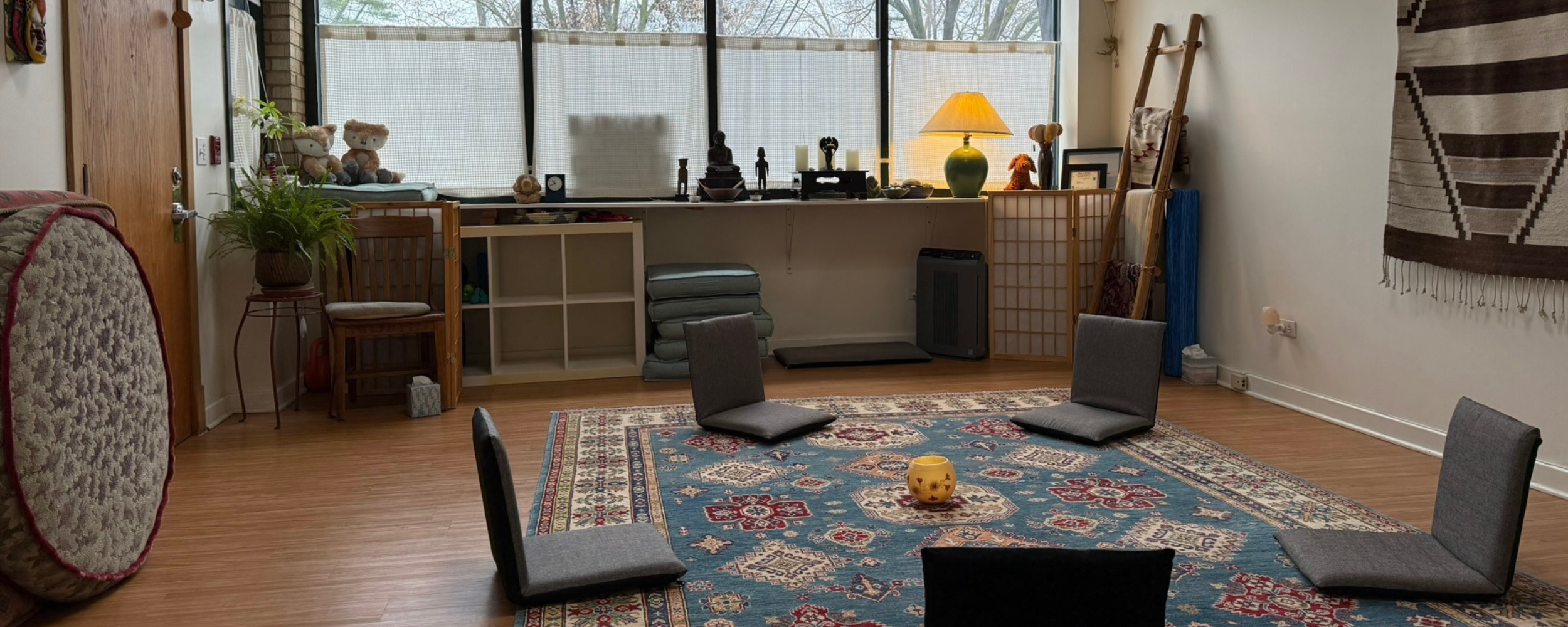
My office in Evanston, Illinois
What is embodied Internal Family Systems?
Embodied Internal Family Systems is the way I bring body, mind, and spirit into the practice of Internal Family Systems (IFS), both in my work with clients and in consultation with therapists.
IFS, developed by Richard Schwartz, understands the personality as an inner community of “parts,” each with its own feelings, perspectives, and protective roles. Some parts work hard to manage daily life, some react when we feel overwhelmed, and others carry the pain of earlier experiences. At the center of the system is the Self—the calm, curious, compassionate, creative presence within each of us that has the capacity to develop relationships with our parts and support healing.
Since my training in IFS with Richard Schwartz in 1998, it has become the foundation of my theoretical framework and a map for understanding the internal system of my clients. Through my background as a dance/movement therapist, teacher of the Discipline of Authentic Movement and consultant, I have come to see how a body-centered approach to IFS allows parts to more fully express themselves in the presence of a compassionate witness who guides the client toward healing and Self leadership.
Why Embodied IFS?
Our parts do not live only in our thoughts. We also experience them through the body—in sensation, posture, gesture, movement, breath, impulse, tension, stillness, and felt experience.
Embodied IFS invites us to listen to these experiences as another way of coming into relationship with our parts.
Sometimes the body reveals something before we have words for it. A tightening in the chest, an impulse to turn away, a change in breathing, or a movement that wants to emerge may become an opening into the experience of a part.
Rather than interpreting these experiences from the outside, we become curious about them from within. We allow the body and the parts themselves to show us what they are holding and what they may need.
The body becomes an active participant in healing.
Body awareness and movement help access unconscious material while gently bypassing the tendency to stay "in the head." As parts become visible through embodied experience, a deeper dialogue between Self and parts can develop.
I provide a nonjudgmental presence that supports curiosity rather than providing interpretation, allowing healing to unfold from within you rather than being imposed from outside.
Research in neuroscience also supports the importance of body-centered approaches, demonstrating that engaging the body can contribute to emotional regulation, greater well-being, and the integration of mind and body. Read my article “Tapestry of a clinician: Blending Authentic Movement and the Internal Family Systems model” in the Journal of Dance & Somatic Practices: Volume 7, Number 2 for more on how these disciplines complement each other and the research into body-centered approaches.
Bringing the BOdy into IFS
In our work together, I may invite you to notice:
• Where do you sense this part in or around your body?
• How does this part breathe?
• What shape does it take?
• Does it want to move or remain still?
• Does it reach, hide, resist, contract, or soften?
• How close or far away does it need you to be?
• What images, memories, sensations, or emotions arise as you stay with it?
These questions can help us encounter parts that may not be as easily reached through words alone.
As a part feels seen and understood—not only cognitively, but in the body—a deeper relationship between Self and the part can develop.
My role is not to interpret your experience for you. I offer a nonjudgmental, curious presence that allows meaning and healing to emerge from within your own system.
Many Doorways Into the Inner World
There is no single way into a person’s inner system.
We may begin by talking about something happening in your life and then turn our attention inward toward a thought, sensation, image, memory, feeling, or movement.
At other times, we may use movement, stillness, drawing, or objects such as stones, scarves, pillows, or small figures to give a part a place outside the body. Creating physical space between you and a part can sometimes help the part unblend, allowing more room for the presence of Self.
The work is collaborative and moves at the pace your system—and especially your protective parts—allows.
I enjoy the mystery of discovering with each person their own way into and through the challenges they face.
Who is this work for?
Embodied IFS may be meaningful for people who:
• Feel limited or stuck in talk therapy alone.
• Want to strengthen their connection to their body and inner experience.
• Experience anxiety, overwhelm, or difficulty making decisions.
• Are navigating grief, relationships, or life transitions.
• Are interested in personal growth, creativity, or spiritual development.
• Are therapists or helping professionals interested in embodied clinical practice and self-care.
Interested in Embodied IFS counseling or consultations? Email me to discuss the best ways to get started. I’d be honored to support your journey.
Frequently asked questions
-
Talk therapy often focuses on analyzing and discussing experiences. Embodied IFS invites you to slow down and notice what's happening in your body in real time (i.e. a tightness in your chest, an urge to curl inward, a shift in your breath) as a way of accessing deeper truths that words alone may not reach.
-
It can be both, depending on the setting. The Discipline of Authentic Movement is a contemplative practice rooted in the relationship between mover and witness. When integrated with Internal Family Systems within a therapy setting, it becomes a body-centered therapeutic approach that allows the body to participate in healing while supporting greater awareness, integration and Self leadership.